
If you’ve been reading our other posts, we’ve walked you thorough the process of getting your first website up and running. Well sort of. You’ve purchased a domain name, purchased hosting, and have engaged with a website developer on getting (and maintaining) a website. But here’s a question we haven’t answered yet – what do you actually need on your website. One page? Ten? Twenty? Well, my advice would be : start with the basics and build from there.
But what are the basics?
These are the five web pages I would recommend to every small business owner.
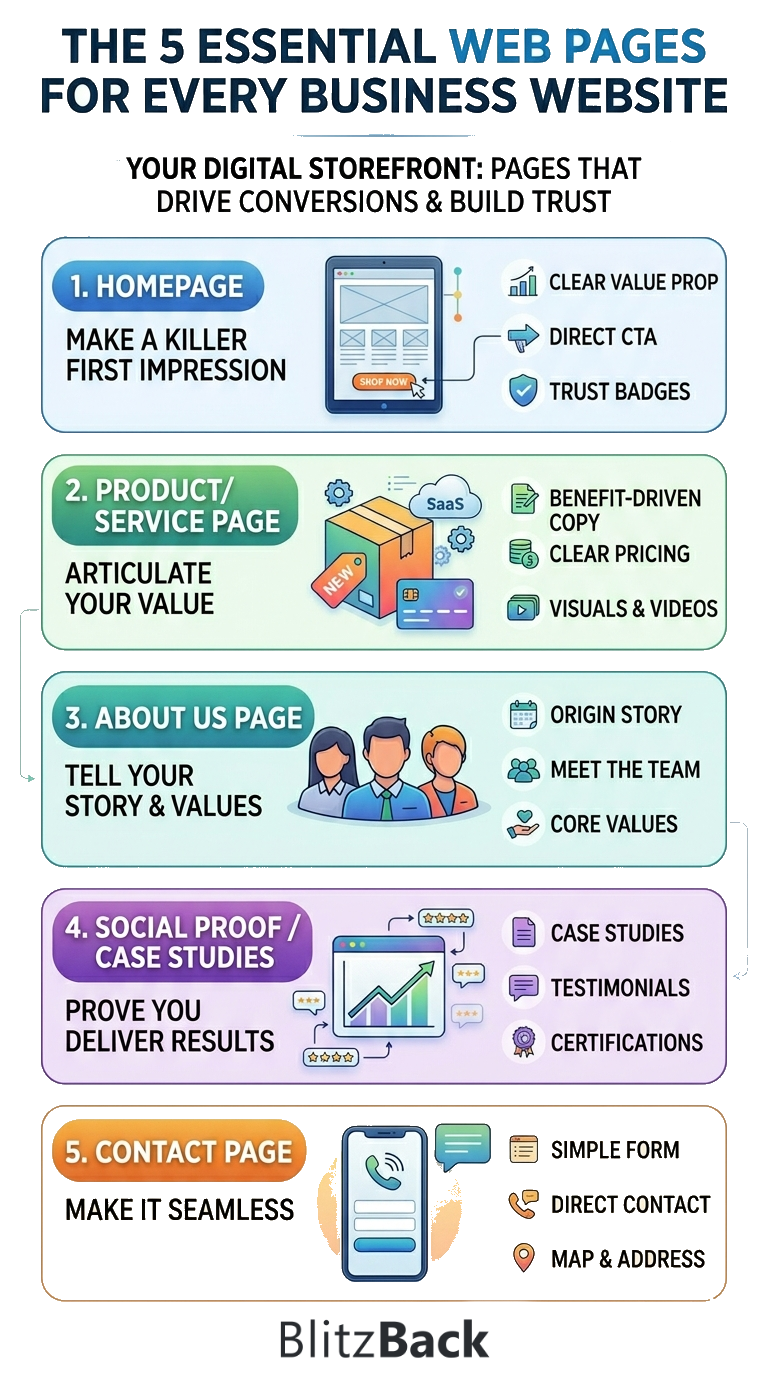
1. Homepage (duh!)
Your homepage is your first and most likely, most important page. It’s your first impression. It’s there not only to guide potential clients through your marketing funnel but also to eliminate people who may have stumbled on your site by accident. Make it very clear what you do and how it will impact your visitor. You should also have a very obvious Call-To-Action (CTA), this is often in the shape of a button strategically placed on the page multiple times. For example “Book Your Headshot Now” or “Schedule a Free Consultation”.
2. A product or service(s) page.
For services, make sure the benefit of the service is clearly articulated. Going back to photography for a minute, you could say “a professional headshot to make you stand out from the competition” if you were doing LinkedIn style headshots. For products, make sure the pricing is clear and the product is well presented (visuals and/or video). Your goal for this page it to move someone’s intent into a more solid decision to purchase or make sure the service offering resonates with the pain point the client is experiencing.
3. About
Think about the About page as a trust marker. Wouldn’t you want to know more about someone before you hand over either personal information (in a contact form) or any kind of monetary details. Tell your story in a unique way. Professional images of you or your team can also go along way to ensuring you’re not a scam company with A.I. or stock imagery.What about the values and integrity you bring to the table. Make it a compelling read and not something people will pass over. People buy from people – make sure they feel you are someone they would like to do business with.
4. Case studies and proof
Another trust marker and one that can help you differentiate quickly from A.I. sites is your social proof / case study page. Show before or after images if you are in a trade, show your portfolio if you are in the arts, given concrete examples of R.O.I if you help companies succeed. Find a way to show a compelling story against each way your business has helped others. This is also an opportunity to show any badges, certifications, awards your company may have received or organizations that you are part of. People are naturally skeptical; give them a reason to put that behind them.
5. Contact
For the contact page, make it extremely easy to navigate. Offer multiple contact points (telephone, email, form, social media accounts). Forms should be paired down to the bare minimum. You don’t need to know the name of their first born to be able to reach out to them. Remember, every piece of information you ask them to fill out is a barrier, the more you ask, the taller that barrier becomes. One thing you should consider that goes hand-in-hand with any kind of information request is a privacy policy page. There may be templates you can use for this that are specific to your industry. It’s not essential but Google does value having a clear policy on your site as another trust factor.
These five pages help keep navigation around your site to a minimum. Ideally you want to guide your visitor from the homepage, to the contact page. They may take small diversions along the way to the services page or the about page, but the goal should be the same – get them to want to talk to you. Don’t offer them 20 different pages and spread the information they might be looking for buried underneath layers of navigation. Simple, direct, concise and get them to contact you. That’s the job of your website and these five pages can help you achieve that goal.
About BlitzBack
We help small business owners get online quickly, with rapid website development, search engine optimisation, digital marketing initiatives and more.

About the author: Brhum Bhatia
Brhum Bhatia is the founder of BlitzBack in Mississauga. He has a Computer Science degree and a background in programming, QA and IT, and took his own photography studio from around 100 results down on Google to number 1 in Burlington, Oakville and Hamilton. He now helps Ontario small businesses get found online.